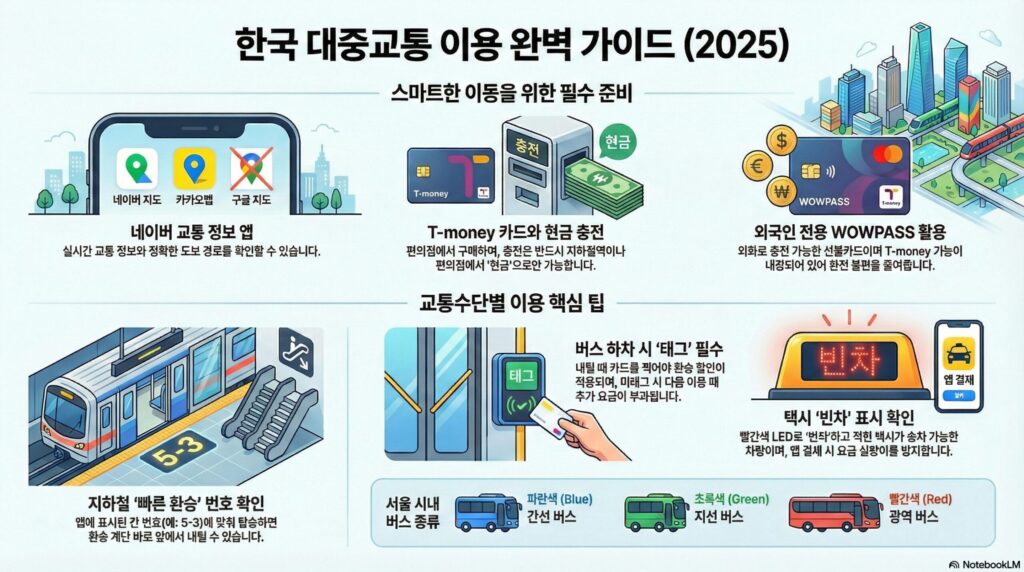
South Korea, particularly Seoul, boasts one of the cleanest, most efficient, and affordable public transportation systems in the world. However, for first-time visitors, the intricate web of subway lines and the rapid-fire pace of the bus system can be intimidating.
One of the most common mistakes travelers make is relying on the wrong apps or not understanding the payment ecosystem. This guide will walk you through everything you need to know to travel like a local, saving you time, money, and stress.
1. The Golden Rule: Don’t Trust Google Maps
If you are coming from North America or Europe, you likely rely on Google Maps for everything. In South Korea, you must switch your habits. Due to government regulations regarding map data, Google Maps does not offer reliable walking directions or real-time transit data in Korea.
Instead, download these essential apps before you arrive:
• Naver Map or KakaoMap: These are the “Google Maps” of Korea. They have English interfaces and provide accurate subway exits, real-time bus arrivals, and the fastest transfer routes.
• Subway Korea: A dedicated app for the metro system that works offline and calculates the best route based on time or fewest transfers.
• Kakao T (or Uber): Essential for hailing taxis without needing to speak Korean.
2. Payment: The T-Money Card & “Cash Only” Rules
South Korea uses a “closed-loop” payment system. Unlike London or New York, you cannot simply tap your foreign contactless credit card (Visa/Mastercard) on the bus or subway turnstile to ride (with the recent exception of some buses in Jeju Island).
What is T-Money?
T-Money is a reloadable transportation card that works on subways, buses, and even in taxis nationwide.
• Where to buy: You can purchase a blank card (usually around 4,000 KRW) at any convenience store (CU, GS25, 7-Eleven) or vending machines at subway stations.
• The “Cash Only” Catch: You can purchase the card with a credit card, but you can usually only reload the balance using Korean Won (Cash). Always keep some cash on hand to top up your card at station kiosks or convenience stores.
• Alternatives: WOWPASS is a popular card for tourists that functions as both a debit card and a T-money card, allowing you to top up using foreign currency via their kiosks.
3. Mastering the Subway (Metro)
The Seoul Metro is extensive, but it is color-coded and numbered, making it navigable even if you don’t read Korean (Hangul).
Navigation Tips
• Follow the Colors: Transfer stations can be massive, but they have colored lines on the floor. If you are transferring from Line 2 (Green) to Line 4 (Blue), just follow the blue line on the ground.
• Use the Numbers: Station names can be hard to pronounce. Memorize the station number instead (e.g., Myeongdong is station 424).
• The “Fast Transfer” Trick: Your map app will often say something like “Fast Transfer 5-3.” This means if you board the train at Car 5, Door 3, you will be right in front of the escalator when you get off.
• Rush Hour Warning: Avoid the “Hell Trains” if possible. Line 2 (Green), Line 4 (Blue), and Line 9 (Gold/Express) are notoriously overcrowded during rush hours (7:30–9:00 AM and 5:30–7:30 PM). If you have luggage, avoid these times.
4. Conquering the Bus System
Buses get you to the nooks and crannies that subways miss, but they require a bit more vigilance.
Understanding Bus Colors
• Blue Buses: Main lines connecting different districts of Seoul.
• Green Buses: Short-distance lines connecting neighborhoods to subway stations.
• Red Buses: Express buses that go to satellite cities outside Seoul (like Suwon or Bundang).
• Yellow Buses: Circular routes within tourist or downtown areas.
The “Tap On, Tap Off” Rule
When you board the bus (front door), you must tap your card. When you exit (back door), you must tap your card again. If you forget to tap off, you will be charged a double fare the next time you use public transit, and you will miss out on the free transfer discount (valid if you transfer within 30 minutes).
Safety Warning: The “Pali-Pali” Culture
Korean bus drivers are known for driving aggressively to stick to tight schedules. This is part of the “Pali-Pali” (Hurry, Hurry) culture.
• Hold On Tight: Do not wait until the bus moves to find a seat. If there are no seats, grab a pole or handle immediately. The bus will accelerate quickly.
• Pre-Game Your Exit: When your stop is announced, press the red “Stop” button immediately. Stand up and move to the back door before the bus comes to a complete halt. If you wait until the bus stops to stand up, the driver may close the door and drive off.
5. Taxis: How to Avoid Scams & Language Barriers
Korean taxis are generally safe and affordable, but hailing one on the street can be difficult if you don’t speak Korean.
• Use the Apps: Kakao T or Uber (often branded as UT in Korea) are lifesavers. They allow you to input your destination in English, see the estimated price, and pay via the app, preventing any potential meter scams or misunderstandings.
• The “Empty” Sign: A red LED sign with lettering in the window means the taxi is “Empty” (Bin-cha) and available. If the light is off or says “Reserved,” they won’t stop.
• Color Matters:
◦ Silver/Orange: Standard taxis (cheaper).
◦ Black: “Deluxe” or “International” taxis. They are more spacious and drivers usually speak English, but they are significantly more expensive.
6. Essential Etiquette: Don’t Be “That” Tourist
To ensure a smooth trip, be mindful of local etiquette.
• Priority Seats (The Ends of the Car): In subway cars, the seats at the far ends are strictly for the elderly and disabled. Do not sit here, even if the train is full and the seats are empty. You will get dirty looks or be scolded.
• Pink Seats: These are reserved for pregnant women. It is best to leave them empty, though you may see non-pregnant locals sitting there occasionally.
• Quiet, Please: The subway is often library-quiet. Talking loudly on the phone or having boisterous conversations is considered rude.
• Backpacks: On crowded trains, wear your backpack on your front to avoid hitting other passengers.
• No Food or Drink: Eating is generally prohibited on city buses and subways. You may be denied boarding if you are holding a disposable coffee cup
FAQ
Q: Can I use Apple Pay or Google Pay for transport? A: generally, no. While some systems are testing it, you should rely on a physical T-Money card or cash to be safe.
Q: Do I need a Korean phone number for Kakao T (Taxi)? A: No, you can use Kakao T without a Korean number, but you may need to select “Pay to Driver” if you cannot link a foreign credit card. Uber (UT) works seamlessly with foreign cards.
Q: Is the subway open 24/7? A: No. Subways usually stop running around midnight. After that, you will need to take a taxi or a “Night Bus” (marked with an ‘N’)
Disclaimer: Information is based on current traveler reports and regulations as of 2024-2025. Prices and app features may change.